For young families and prospective parents in Singapore, purchasing a residential property is rarely just a lifestyle or financial decision; it is deeply intertwined with their children’s education pathway. The Ministry of Education’s (MOE) Primary One (P1) registration framework places significant weight on home-to-school distance, particularly in Phase 2C—the open registration phase for children without prior alumni, staff, or clan affiliations. Securing a home within the coveted 1-kilometre or 1-to-2-kilometre radius of established primary schools can dramatically improve balloting odds, making educational proximity a central driver of long-term property demand and value resilience.
The Home-School Distance Hierarchy and Balloting Mechanics
When a primary school’s applications exceed its available vacancies during Phase 2C, admission is determined through a clear priority ladder:
- Singapore Citizens (SC) living within 1km
- Singapore Citizens living between 1km and 2km
- Singapore Citizens living outside 2km
- Permanent Residents (PR) living within 1km
- Permanent Residents living between 1km and 2km
- Permanent Residents living outside 2km
Balloting is triggered only within the specific category where demand surpasses supply. For instance, if vacancies are filled entirely by citizens residing within 1 kilometre, applicants in the 1-to-2-kilometre band are automatically eliminated without a ballot.
Furthermore, MOE calculates home-school distance based on the School Land Boundary (SLB) system. Rather than measuring from a school’s central administrative building, distance is calculated from any point along the school’s official perimeter to the applicant’s specific residential block. This methodology frequently brings more residential blocks within the crucial 1-kilometre benchmark, expanding priority catchment zones.
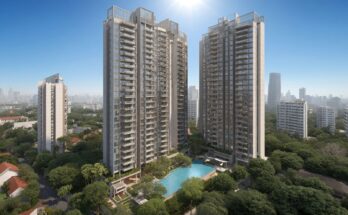
Family-centric buyers evaluating western residential corridors often prioritize locations surrounded by established community infrastructure. In master-planned developments like Solano Grand, situated in District 23, proximity to reputable neighborhood schools such as West View Primary and West Spring Primary offers young couples a reliable educational anchor. This close geographic proximity simplifies morning transit routines while maintaining strong Phase 2C priority standing.
The 30-Month Residency Obligation
To ensure fairness and prevent short-term leasing purely for school admission, MOE enforces a strict 30-month residency rule. A child who gains priority admission based on home-school distance must reside at that registered address for at least 30 months.
For families purchasing an uncompleted property directly from a developer, this timeline holds important nuances:
- Properties Under Construction (BUC): Parents can register their child using the address of the newly purchased home, provided they submit an official undertaking to move into the unit within a specified period following the Temporary Occupation Permit (TOP).
- Commencement of the 30-Month Clock: For newly completed homes, the 30-month residency requirement officially commences from the date the family physically moves into the property rather than the date of P1 registration.
- Regulatory Compliance: Failure to fulfill the continuous 30-month stay requirement allows MOE to reassign the child to another school with available vacancies.
Capital Protection and Liquidity in Family Districts
Properties situated within 1 kilometre of high-demand primary schools command a measurable premium in the secondary resale market. Even beyond top-tier brand-name institutions, well-regarded neighborhood schools create a perpetual floor of buying demand from successive waves of young parents.
When evaluating expansive developments in northern growth precincts, projects such as Wynwood Grand in Woodlands present distinct educational accessibility. With multiple established primary schools—including Innova Primary, Woodgrove Primary, and Si Ling Primary—clustered within the immediate 1-kilometre radius, multi-generational households enjoy strong schooling options across several registration phases. This robust educational network shields property values from cyclical downturns, ensuring healthy buyer interest when the development eventually reaches the open resale market.
Verifying Boundaries Before Commitment
Because postal district boundaries do not always align with School Land Boundaries, prospective buyers should never rely on rough map estimates. Utilizing official government mapping tools like the Singapore Land Authority’s OneMap School Query ensures that the exact block and unit number fall decisively within the desired 1-kilometre boundary line before finalizing any property commitment.