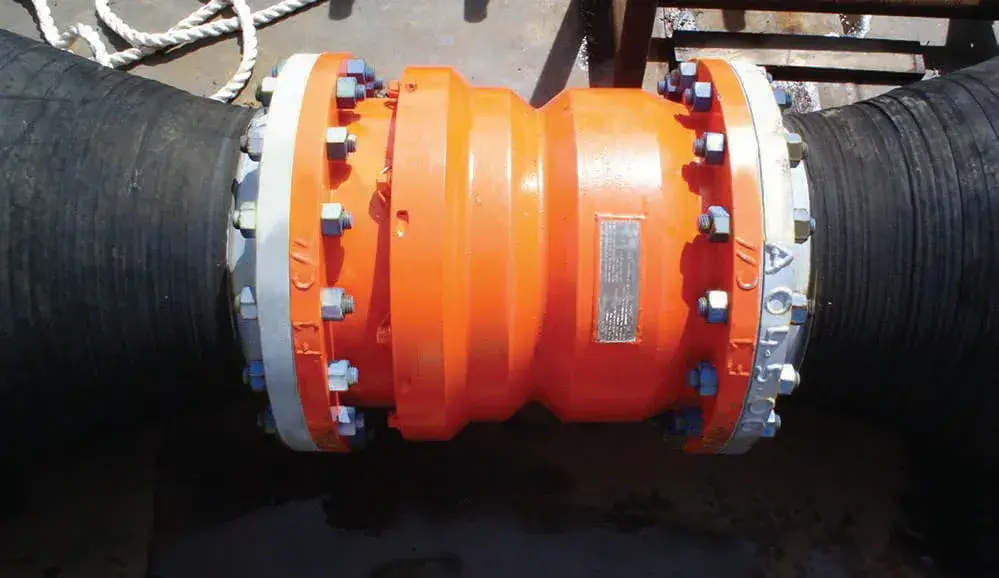
Offshore fluid transfer is one of the most demanding and hazardous operations in the marine industry. Whether loading crude oil from a tanker or discharging refined products at sea, the consequences of a failure in the transfer system can be severe, from costly downtime and damage to assets to catastrophic environmental damage and risk to personnel. This is why the marine breakaway coupling has become an indispensable safety device in applications worldwide.
In this article, we explore what a marine breakaway coupling does, how it works, why it matters, and why Gall Thomson is recognised as the industry standard in MBC technology.
What Is a Marine Breakaway Coupling?
A marine breakaway coupling (MBC) is a safety device installed within a hose transfer system to protect both people and the environment during fluid transfer. It acts as an identifiable safe parting point within the hose string, engineered to activate and shut off product flow automatically, without requiring any intervention from personnel, when either an undue tensile load or an extreme pressure surge is detected.
The marine breakaway coupling is designed to separate cleanly under these conditions, relieving dangerous tension and pressure in the hose before it can rupture. The result is a controlled separation that minimises the risk of spillage, prevents fluid from contaminating the environment, and safeguards the hose systems, vessels, and surrounding infrastructure.
How Does a Breakaway Coupling Activate?
An MBC is designed to activate under two primary conditions: undue tensile load on the hose or an unacceptable pressure surge.
In a typical scenario, a loading or discharging vessel is connected to a hose string that runs between the ship and a terminal or another vessel. If the tanker drifts or breaks away from its mooring due to poor weather, tidal forces, or human error, the forces applied to the hose increase rapidly. Once these forces exceed the MBC’s pre-set parting load, the coupling activates: it separates at the safe parting point, and the internal valve automatically closes, shutting off product flow on both the upstream and downstream sides of the disconnection.
This automatic activation and valve closure happen in a fraction of a second. The entire process is engineered to relieve pressure and prevent a spill before damage can occur. The breakaway coupling acts as a fast-response safety fuse in the fluid transfer system, eliminating the need for manual shutdown or emergency intervention.
The Gall Thomson MBC: Industry Standard in Marine Breakaway Couplings
Gall Thomson Environmental Ltd., based in Great Yarmouth, Norfolk, is widely regarded as the industry standard in marine breakaway coupling technology. The MBC has been developed through decades of operational experience, with designs that have constantly evolved in response to real-world data gathered from activation events, servicing, and refurbishment across a diverse range of offshore applications.
Gall Thomson has monitored, analysed, and reacted to real-world operational, activation, servicing, and refurbishment data by evolving the designs and manufacturing procedures of its marine breakaway couplings. This commitment to continuous improvement has resulted in a latest generation of MBCs that reflect vast accumulated knowledge of the conditions that test the efficiency and safety of hose transfer systems in the offshore environment.
The MBC range is designed to activate only in the circumstances for which the breakaway coupling is designed. It is trusted by operators in some of the world’s most demanding offshore fluid transfer environments, and its reliability under operating conditions makes it the preferred choice for engineers who need absolute confidence in their transfer system’s safety performance.
Petal vs Flip-Flap: MBC Valve Types
Gall Thomson offers two principal valve types for its safety breakaway coupling range, each engineered for specific operational requirements.
The Petal Valve MBC
The Petal Valve MBC is suited to higher viscosity products such as crude oil. Its full-bore design provides zero headloss, meaning there is no restriction to fluid flow during normal transfer operations, and it is fully piggable, making it compatible with pipeline inspection and cleaning procedures. This design is ideal for large-volume offshore loading operations where operational efficiency is paramount, and any headloss in the hose system would negatively impact transfer rates.
The Flip-Flap Valve MBC
The Flip-Flap Valve MBC was engineered specifically for low-viscosity products such as kerosene and LPG. The flip-flap valve design offers low headloss and 100% shut-off, ensuring that when the marine breakaway coupling activates, both the upstream and downstream flow are cleanly sealed. The flip-flap mechanism is built for rapid, reliable disconnection. Once the MBC separates, the flip-flap valve closes immediately to prevent any fluid from escaping into the marine environment.
Both valve types are available across the Gall Thomson MBC product family, including the Petal Valve MBC, Petal17, PetalC, and Flip-Flap Valve MBC models, giving engineers the flexibility to select the right breakaway coupling configuration for their specific installation, product type, and operational requirements.
Why Marine Breakaway Couplings Are Essential in Offshore Operations
The offshore marine environment is inherently unpredictable. Vessels are subject to sudden changes in sea conditions, weather, and mooring status. The dangers of tanker breakouts during loading and unloading operations are ever-present and can occur with little warning. In this context, a single uncontrolled separation of a hose transfer system without an MBC in place can cause a spill that carries devastating environmental, financial, and reputational consequences.
Marine breakaway couplings, therefore, are designed to prevent this. In the event of an extreme pressure surge or a tanker breakout, the MBC automatically activates and shuts off product flow before spillage can occur. The breakaway coupling protects the hose, the transfer system, and surrounding assets. It protects the marine environment from pollution, and personnel from the dangers of a rupturing hose or uncontrolled fluid release.
Beyond preventing spills, the marine breakaway coupling also minimises disruption to operations. Because the MBC provides controlled separation rather than a catastrophic hose failure, downtime and clean-up costs are greatly reduced. The risk of damage to transfer systems and assets is minimised, and the overall risk to the workforce is substantially lower. For operators managing high-frequency fluid transfer operations offshore, these operational benefits are as significant as the safety and environmental protections they provide.
Installation, Refurbishment, and Long-Term Operational Value
One of the key advantages of the Gall Thomson MBC is its design, which simplifies installation within existing hose transfer systems. The coupling can be integrated into new installations or retrofitted to existing hose systems with minimal disruption to operations, making it a practical choice for operators upgrading their offshore fluid transfer safety infrastructure.
After activation, Gall Thomson MBCs can be refurbished and returned to service, which is a significant operational advantage for operators. Refurbishment programmes ensure that MBCs maintain their design performance characteristics and continue to meet the pre-set tensile and pressure activation requirements. This long-term serviceability, combined with the product’s proven durability, makes the Gall Thomson MBC one of the most effective safety investments available for offshore applications.
Gall Thomson offers comprehensive technical support to help engineers and operators select the right MBC for their specific application, ensure correct installation, and maintain the product over its operational life. This end-to-end support is part of what has made the Gall Thomson marine breakaway coupling the trusted choice for fluid transfer operations worldwide.
Conclusion
The marine breakaway coupling is not simply a safety device designed to prevent spills; it is an operational essential for any offshore fluid transfer system. By providing a safe parting point that activates under undue tensile forces or extreme pressure surges and vessel movement, the MBC ensures that tanker breakouts and pressure events result in controlled separation rather than catastrophic failure. It protects the hose, the fluid transfer system, the vessel, the environment, and the people who depend on safe, efficient offshore operations.
With decades of real-world operational data driving continuous product evolution, zero headloss performance in applicable designs, durable and compact construction, and full refurbishment support, the Gall Thomson MBC delivers the reliability, operational efficiency, and environmental protection that offshore fluid transfer operations demand.
To learn more about Gall Thomson’s marine breakaway coupling range, or to speak with an engineer about the right MBC solution for your installation, visit www.gallthomson.com.